
Product Manager vs Software Engineer salary in India (2026 comparison)
A detailed side-by-side comparison of Product Manager and Software Engineer compensation in India, including base pay, growth trajectory, and which path pays more at each career stage.

Zaprill Team
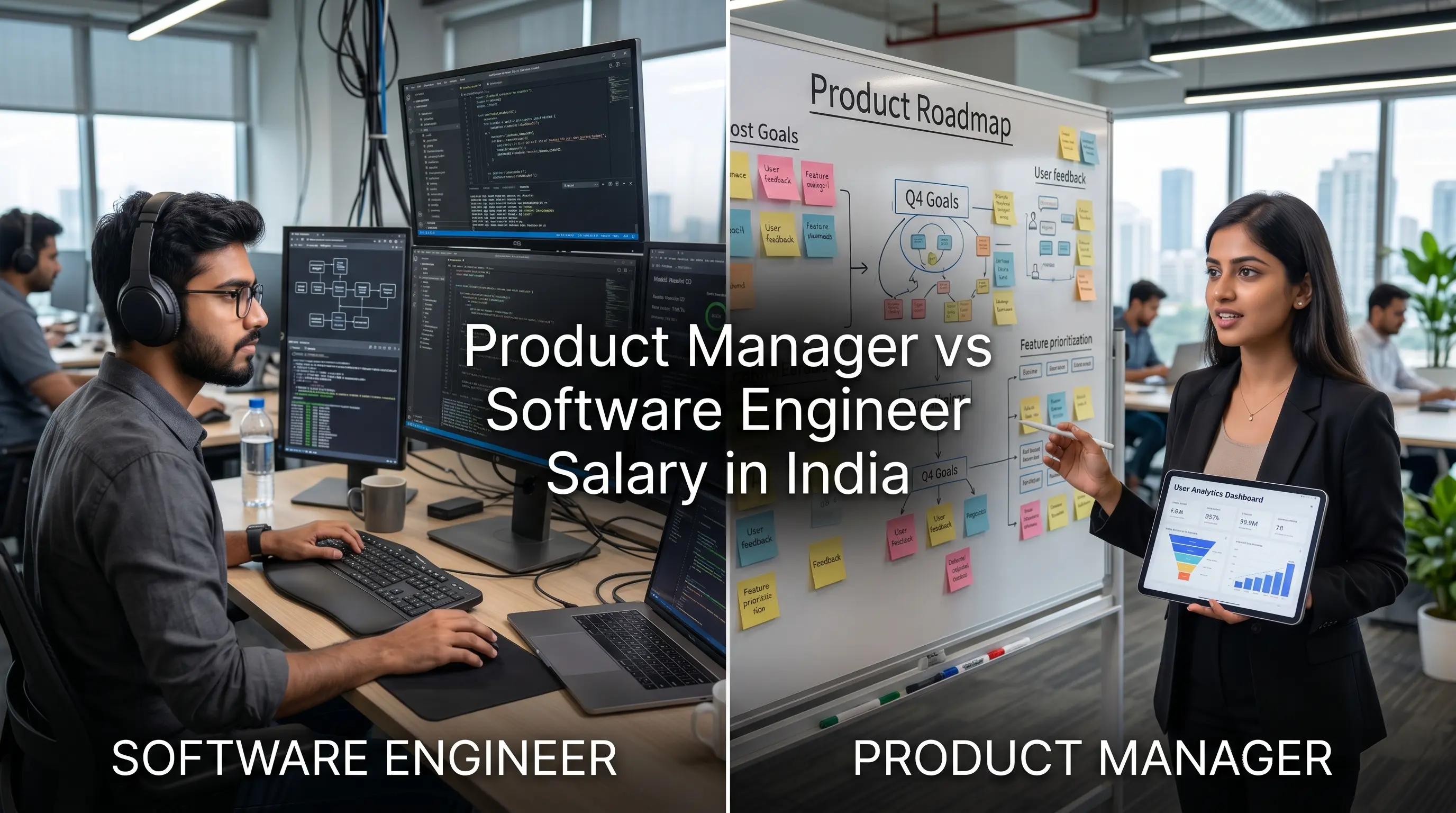
The Core Differences in Value Creation
To truly understand the diverging salary trajectories between Product Managers (PMs) and Software Engineers (SWEs) in the complex Indian tech ecosystem, one must first deeply understand exactly how each distinct role fundamentally creates value for the business. The relationship is highly symbiotic, yet the underlying compensation models are often structurally different based primarily on the perceived scarcity and immediate utility of their respective skill sets.
Software Engineers are the builders. Their value creation is intensely tangible, highly technical, and immediately visible. They construct the actual product, ruthlessly optimize its performance, ensure massive system scalability, and directly execute the company's grand vision in raw code. The barrier to entry for this role is extremely high, requiring years of specialized technical study, innate mathematical aptitude, and continuous, grueling upskilling just to remain relevant. Because the rare ability to write high-quality, efficient, production-grade code is objectively measurable and constantly in short supply, base salaries for SWEs—especially at the crucial entry and mid-levels—are generally much higher, more predictable, and more consistent than for PMs.
Product Managers, conversely, are the strategic directors. Their initial value creation is abstract and often invisible. A PM doesn't physically write the code that generates daily revenue; instead, they are heavily responsible for discovering exactly what the volatile market actually wants, defining a winning product vision, ruthlessly prioritizing the engineering backlog, and continuously aligning disparate cross-functional teams (engineering, design, marketing, aggressive sales) toward a single, unified goal. The PM essentially ensures that the incredibly expensive engineering resources are building the right thing, rather than building the wrong thing very efficiently. The barrier to entry is often less technically rigid but requires a highly complex, difficult-to-test amalgamation of sharp business acumen, deep user empathy, rigorous data analysis, and exceptional, high-stakes stakeholder management.
Entry and Mid-Level Compensation: The Engineering Premium
At the entry and mid-levels (typically defined as 0 to 5 years of experience), Software Engineers almost universally and consistently out-earn Product Managers across the entire Indian tech market. This notable 'engineering premium' is primarily driven by the concept of immediate, measurable utility. A junior SWE can begin actively contributing to the codebase, pushing commits, and closing simple bugs within their very first month, providing an immediate, highly visible ROI to the company.
An Associate Product Manager (APM), however, requires significantly more intensive ramp-up time. They must deeply understand the nuanced market dynamics, navigate the complex internal company politics, and grasp the intricate product architecture long before they can confidently make strategic decisions that directly drive revenue. Companies are generally willing to pay a massive upfront premium to secure raw technical talent early, leading to highly inflated starting salaries for engineers graduating from top-tier Indian institutions (like IITs, NITs, and BITS) compared to standard entry-level product folks.
During these early, formative career stages, an engineer's salary trajectory is usually incredibly steep and highly predictable. It is tied directly to objectively mastering new frameworks or demonstrating increased, measurable coding velocity. A mid-level engineer who quickly becomes proficient in a high-demand, niche tech stack (such as Applied AI, LLM integration, or complex distributed Data Engineering) can command rapid, substantial pay hikes. The mid-level PM's salary growth, however, is often noticeably slower and more erratic, as their direct business impact is significantly harder to quantify until they have successfully, publicly launched a major, revenue-generating feature from end to end.
The Senior Level Convergence: Leadership and Leverage
As professionals transition into senior roles (6 to 10+ years of deep experience), the distinct compensation trajectories begin to dramatically converge, and in many high-growth, heavily funded startups, explicitly cross over. This exact intersection is where the critical economic concept of 'leverage' entirely dictates compensation.
A Senior Software Engineer possesses immense technical leverage. They architect robust systems that serve millions of concurrent users and heavily mentor junior developers. However, their ultimate leverage is logically constrained by their own individual physical output and the specific, narrow technical domain they currently control. To significantly break through the absolute upper compensation bands, a SWE must successfully transition into an Engineering Manager or Principal Architect role, which paradoxically requires the very 'soft skills' (communication, alignment, strategy) that PMs utilize daily.
A Senior Product Manager or Group Product Manager, by contrast, operates with massive, unconstrained business leverage. They are no longer just writing PRDs or prioritizing Jira tickets; they are actively dictating the strategic, long-term direction of entire product lines, directly owning the crucial P&L (Profit and Loss), and frequently presenting to the board of directors. If a highly skilled Senior PM correctly identifies a massive new market opportunity and efficiently guides the engineering team to build the perfect solution, they can almost single-handedly add millions of dollars to the company's valuation. Because their daily strategic decisions directly, undeniably impact the company's overall revenue trajectory, senior PMs often successfully negotiate significantly higher variable bonuses and much larger equity grants than their pure engineering counterparts.
At this elite senior level, the overall compensation package shifts heavily. While the base salary for a Staff Engineer and a Group PM might be surprisingly similar on paper, the PM often receives a much larger, more lucrative percentage of their total compensation in the form of aggressive, performance-based bonuses tied directly to product adoption, retention metrics, and strict revenue targets.
The Impact of Startups vs. Enterprises
The specific type and stage of the company you join drastically and fundamentally influences this ongoing compensation dynamic. In early-stage, deeply technical startups (Seed or Series A), raw engineering talent is the absolute lifeblood of the company. The visionary founders are often acting as the de facto Product Managers, meaning the absolute highest salaries and the largest equity chunks are aggressively, exclusively reserved for the founding engineers who can physically build the MVP (Minimum Viable Product) and get it to market quickly.
However, as the successful startup aggressively scales into a mature, established 'scale-up' (Series C and beyond) or an enormous, publicly traded enterprise, the entire dynamic flips. The core technology has already been built and stabilized. The new, terrifying existential challenge for the company is scaling the active user base, discovering new, adjacent revenue streams, and fiercely maintaining product-market fit against aggressive, well-funded competitors. In these highly mature organizations, elite Product Leadership becomes arguably vastly more critical than elite Engineering execution. The compensation bands at the Director, VP, and C-suite levels heavily, unapologetically reflect this massive shift toward strategic, revenue-driving business leadership.
Ultimately, the final answer to whether a Product Manager or a Software Engineer earns more depends entirely on the specific career stage, the nuanced company context, the broader macroeconomic environment, and the individual's proven, undeniable ability to drive quantifiable, massive business outcomes.

Zaprill Team
Market Research
Providing market-leading insights on career strategy, technical compensation, and negotiation.
Recommended for you
More insights to help you navigate your career and market value.

Navigating Tech Career Progression: IC vs. Engineering Manager in India
Should you stay on the Individual Contributor (IC) track or pivot to Engineering Management (EM)? Here is a data-backed breakdown of the salary, impact, and skill differences in India.

How to Answer 'What is Your Expected Salary?' Without Losing Leverage
The expected salary question is a trap. Here is the step-by-step psychological framework to handle it effectively and maximize your offer.

5 ATS Formatting Rules You Cannot Afford to Ignore in 2026
Your resume's visual layout is your biggest vulnerability. Discover the 5 rigid ATS formatting rules that determine whether your resume gets read or ignored.